Multimodal Memory Puzzles

ATM-Bench

According to Me: Long-Term Personalized Referential Memory QA

Multimodal, multi-source personal memory question answering over long time horizons

ATM-Bench is built for the kind of memory questions that sound casual to humans but break systems in practice: outdated receipts, weak location clues, ambiguous references, and moments where the right answer is to abstain.

Jingbiao Mei, Jinghong Chen, Guangyu Yang, Xinyu Hou, Margaret Li, Bill Byrne
University of Cambridge
~4 years personal memory horizon Long-range references across years, not short chat windows.
3 sources images + videos + emails The answer often lives across multiple modalities at once.
2.25M token context A realistic haystack for retrieval, grounding, and reasoning.
~30% multi-evidence questions Single-pass lookup is often not enough to answer correctly.
<20% accuracy on Hard The hardest split still exposes large gaps in current systems.
Overview

Personalized assistants should remember lived experience, not just chat logs. ATM-Bench targets the harder regime: multimodal, multi-source personal memory QA grounded in real evidence from images, videos, and emails. The challenge is not merely finding one matching memory item. It is deciding which pieces still hold, which ones conflict, and when the evidence is not strong enough to answer at all.

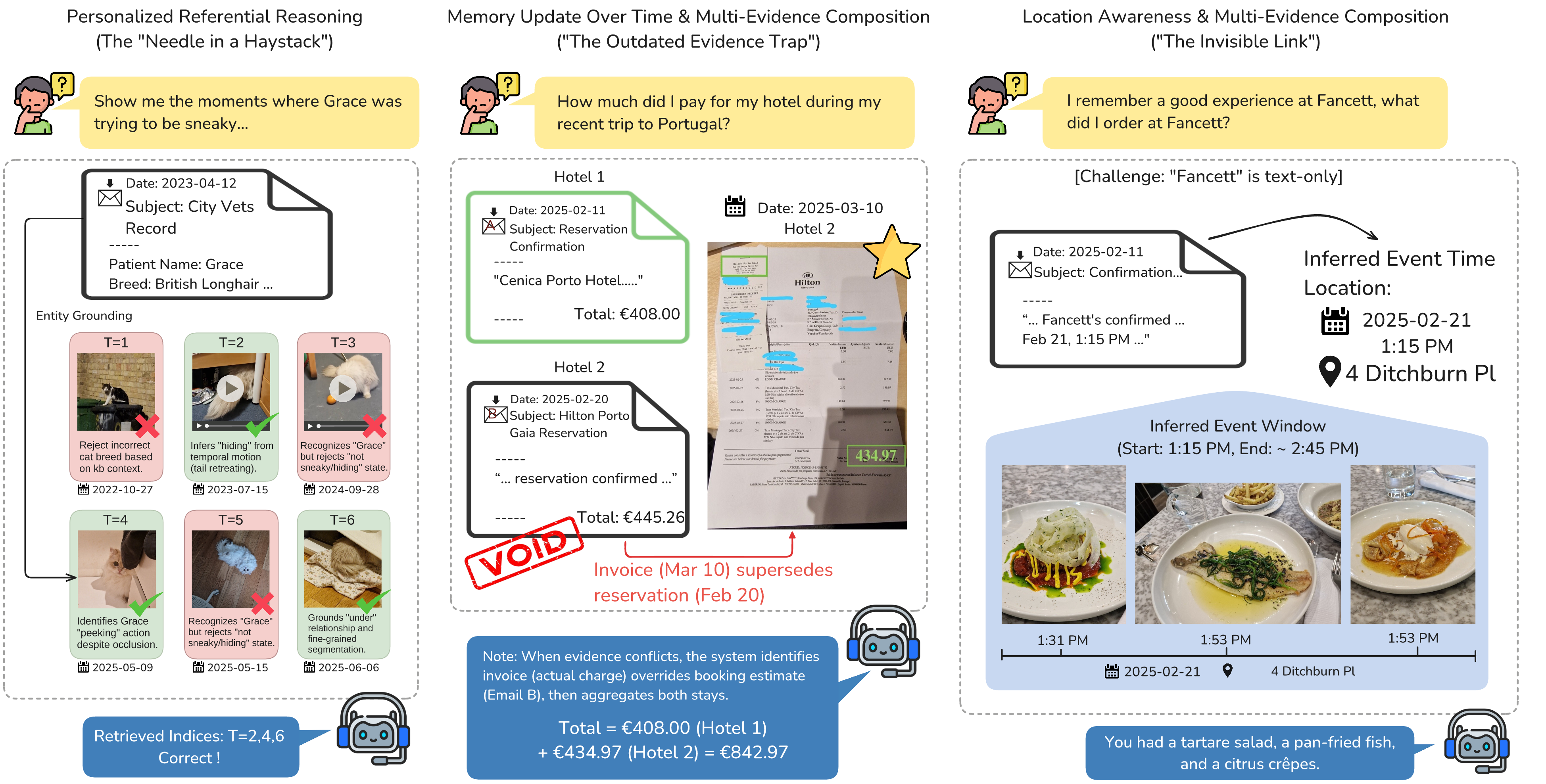
ATM-Bench overview diagram
The benchmark teaser figure. The cards below unpack these cases into clearer, demo-friendly stories.

Four Memory Puzzles

These are the kinds of examples that make ATM-Bench memorable. Each one looks natural at the surface and then turns into a retrieval, grounding, and reasoning trap.

Case 01

Personal Reference Resolution

"Show me the moments where Grace was trying to be sneaky."

images videos entity grounding

Why it is tricky. The assistant must resolve who "Grace" is, reject visually similar but wrong moments, and distinguish "trying to hide" from merely appearing in frame.

What weak systems do. They anchor on the wrong pet attributes or retrieve frames that look close but do not support the sneaky state.

Correct behavior. Ground the entity first, then retrieve only the evidence that truly supports the hidden or peeking action.
Case 02

Conflicting Evidence Over Time

"How much did I pay for my hotel during my recent trip to Portugal?"

emails receipts temporal update

Why it is tricky. A reservation email and a later invoice disagree, and the final answer requires composing evidence across two stays.

Typical model mistake. Trust the earlier booking estimate, ignore the superseding invoice, and miss the conflicting-evidence update.
Correct behavior. Prefer the final invoice over stale booking evidence, then aggregate both hotels to reach the grounded total of EUR 842.97.
Case 03

The Invisible Link

"I remember a good experience at Fancett. What did I order at Fancett?"

emails photos location inference

Why it is tricky. "Fancett" appears in text-only confirmation evidence, while the dishes appear only in photos. The system has to infer the event window, venue, and then connect the right images.

Failure mode. Retrieve nearby meal photos from the same day without grounding them to the correct place and time.

Correct behavior. Infer the restaurant visit from the confirmation, narrow the time window, and only then read the dishes from the linked visual evidence.
Case 04

When the Right Answer Is "I Don't Know"

"Which wine did I order at Fancett that night?"

abstention evidence sufficiency hallucination control

Why it is tricky. The assistant may recover the restaurant and the meal, yet still lack any grounded evidence about the drink order.

What weak systems do. Fill the gap with a plausible but unsupported guess once some nearby memories have been found.

Correct behavior. Return an abstention because the retrieved memories support the dishes, not the wine.

What ATM-Bench Measures

The benchmark is not just larger. It is structured around failure modes that matter for real personal-memory assistants: weak references, stale evidence, cross-source composition, and calibrated abstention.

PR

Personalized references

Resolve names, nicknames, and indirect descriptions against personal multimodal memories.

LA

Location awareness

Infer where an event happened even when the place appears only in sparse, indirect evidence.

MUT

Memory updates over time

Prefer later and more authoritative evidence when bookings, plans, and outcomes conflict.

ME

Multi-evidence composition

Compose several partial clues before answering, instead of trusting the first matching item.

ABS

Abstention

Decline to answer when the evidence is insufficient, even if a plausible guess is tempting.

Compare ATM-Bench against prior memory benchmarks
Aspect Prior Benchmarks ATM-Bench
Memory modality and source Mostly dialogue-only or single-modality settings Images + videos + emails in one benchmark
Data origin Primarily synthetic or hybrid data Human-curated personal memory QA with evidence labels
Core memory abilities Partial coverage Personalized referential reasoning, location awareness, memory updates, multi-evidence composition, and abstention
Scale and horizon Typically smaller or narrower settings ~12k memory items, ~1.1k QA, years-long horizon, 2.25M-token context
Multi-evidence burden Lower multi-evidence proportion in common settings ~30% of questions require multi-evidence composition

Methods

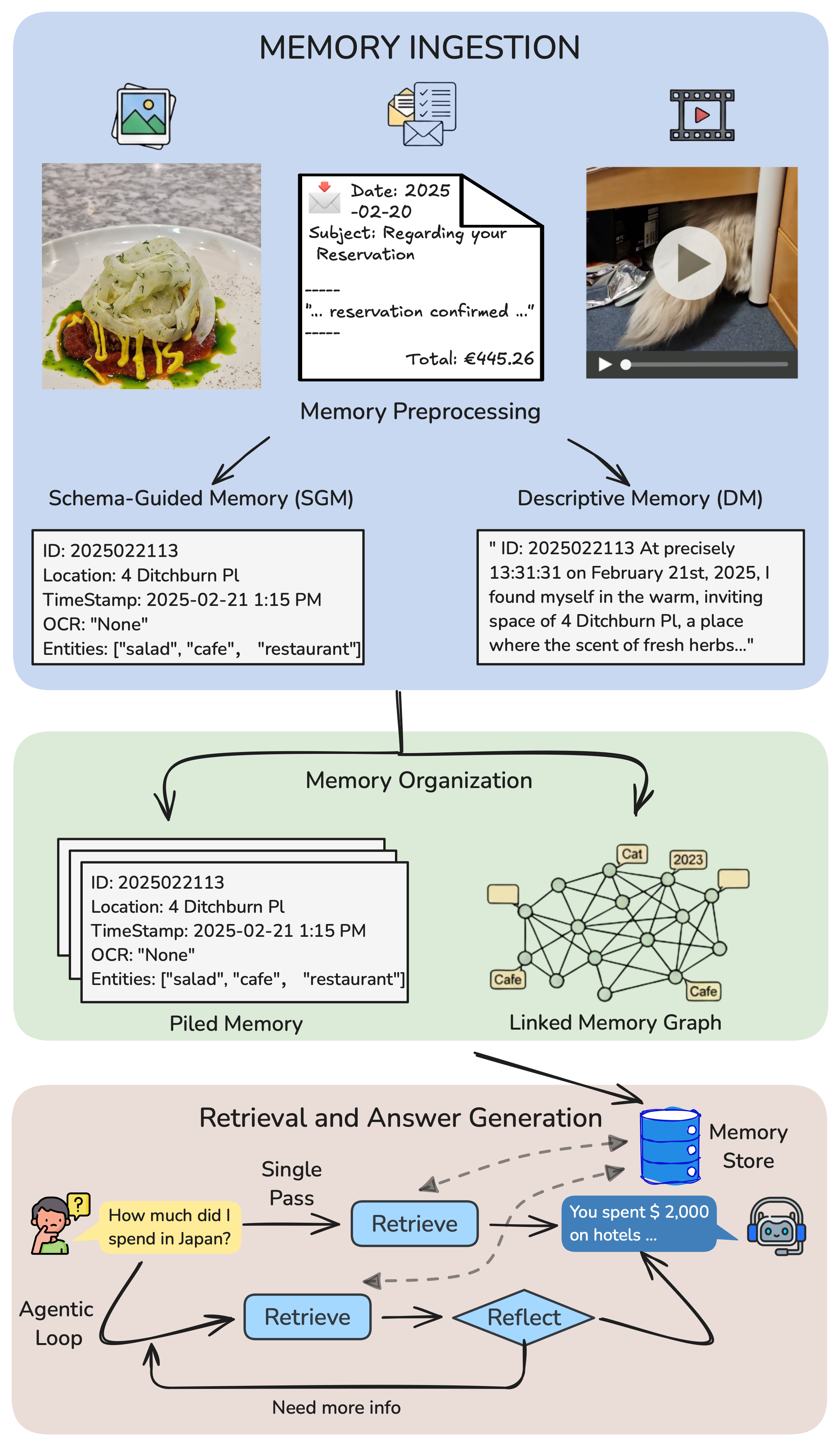
ATM models the assistant as a staged memory pipeline: ingest multimodal artifacts, organize them into memory structures, retrieve evidence under budget, and only answer when the supporting memories are grounded.

ATM Method diagram
ATM method: memory ingestion, organization, retrieval, and answer generation.

Citation

If you use ATM-Bench in your research, please cite:

@article{mei2026atm,
  title={According to Me: Long-Term Personalized Referential Memory QA},
  author={Mei, Jingbiao and Chen, Jinghong and Yang, Guangyu and Hou, Xinyu and Li, Margaret and Byrne, Bill},
  journal={arXiv preprint arXiv:2603.01990},
  year={2026},
  url={https://arxiv.org/abs/2603.01990},
  doi={10.48550/arXiv.2603.01990}
}

Acknowledgement

This page was adopted from the Nerfies project page, licensed under a Creative Commons Attribution-ShareAlike 4.0 International License. Many thanks to the Academic Project Page Template.